Agentic AI in accounting: a plain guide for 2026
By Team · October 24, 2026
Category: ai-automation
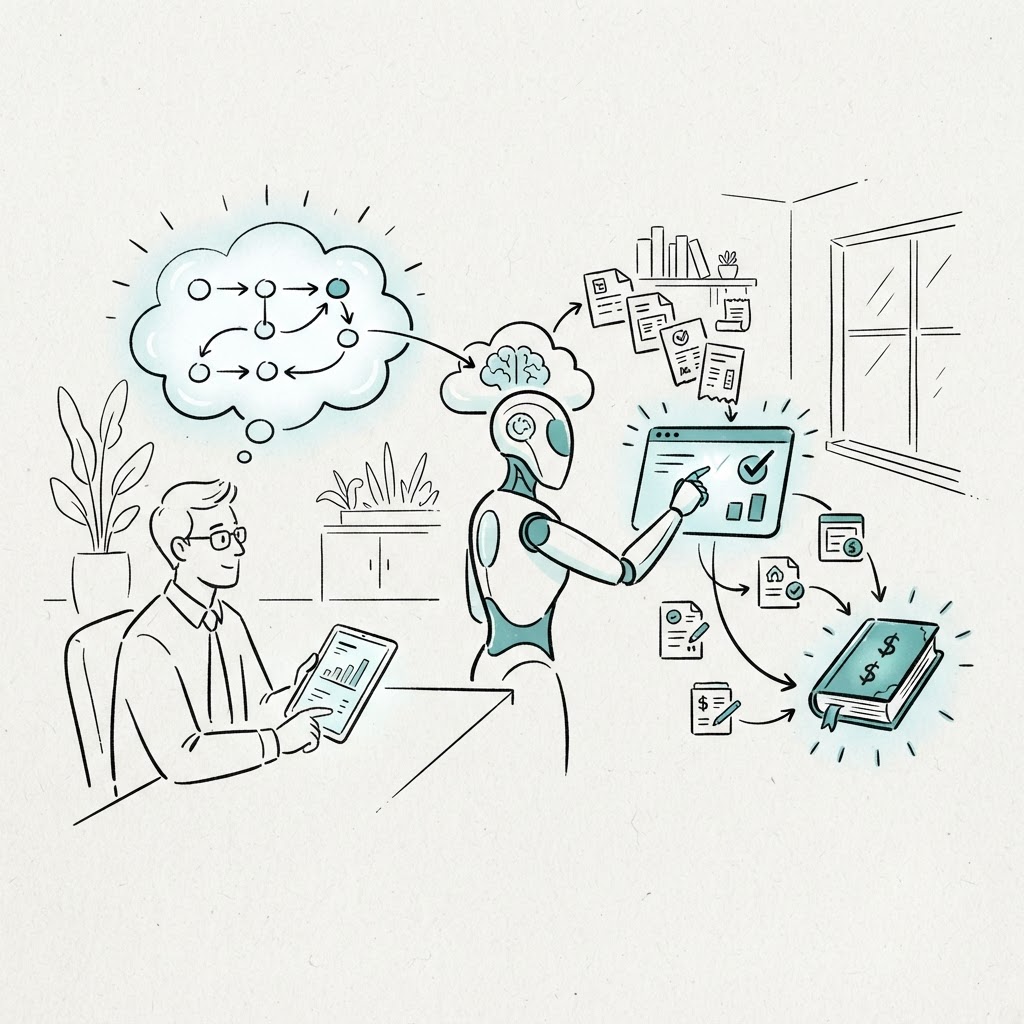
Agentic AI plans multi-step work, decides within limits, and acts. Here is what that means in accounting, where it fits today, and where it still needs a person.
Key takeaways
The problem Vendors use the word agentic for everything from a macro to a full workflow engine, so finance leaders cannot tell what they are buying.
Core insight The test for an agent is not the model behind it but whether it plans steps, decides inside defined limits, and leaves a record a reviewer can follow.
Practical outcome Ask any vendor to show one workflow end to end, including the exception it refused to handle, and size your first project around that.
Say a controller sits through a vendor demo and hears the word agentic again and again. The product turns out to be a rule that sends an email when an invoice is late. That gap between the label and the thing is the main obstacle to buying anything sensible in this category.
This guide gives a working definition, separates agents from the tools they get confused with, and shows where agentic systems fit in accounting today. It also says where they do not.
The state of accounting automation today
Most finance teams already automate something. Bank feeds import transactions. Rules code recurring bills. A workflow tool routes approvals. These tools work, and they share one trait: a person designed every branch in advance.
That design burden is the constraint. A rule handles the case someone anticipated. The invoice that arrives with a missing purchase order, a new remittance address and a partial shipment is the case nobody anticipated, so it lands in a queue and a senior person fixes it by hand.
The work that remains manual in most teams is therefore not the repetitive work. It is the work that needs a decision. Agentic systems aim at that layer.
What agentic actually means

We use a narrow definition. An agentic system plans a multi-step task, makes decisions inside limits you define, and carries out the steps without a person approving each one. It also records what it did and why.
Each part of that definition rules something out.
- Rules and macros do not plan. They run a fixed sequence.
- Robotic process automation (RPA) repeats recorded screen actions. It follows a script and breaks when the screen changes. See the general description of robotic process automation for the standard definition.
- Copilots suggest, and a person acts. They help with drafting and lookup but they do not finish the task.
- Agents take a goal such as "clear the exceptions on this bank account", choose the steps, call the tools, and stop when they reach the edge of their authority.
The phrase "inside limits" carries the weight. An agent with no limits is a risk. An agent with a written limit, such as "match within a defined tolerance, never post above this amount, never touch a closed period", is a controlled process.
Anthropic's engineering team describes the same distinction between fixed workflows and agents that direct their own steps in Building effective agents. Their advice is also ours: use the simplest design that does the job, and add agent behavior only where fixed steps fail.
The workflows where it fits

Agentic systems earn their place where the work has many small decisions and a lot of context. In accounting that points to a short list.
Reconciliation
Matching is easy when amounts and references agree. Agents help with the rest: one payment covering three invoices, a fee netted from a deposit, a date that slipped across month-end. The agent proposes a match with its reasoning and posts only what falls inside your tolerance.
Accounts payable exceptions
Three-way matching fails for ordinary reasons. The agent can read the invoice, find the purchase order, see that the quantity was a partial delivery, and route the case to the right buyer with the evidence attached.
Month-end close
Close is a dependency graph: accruals wait for approvals, approvals wait for receipts. An agent that tracks which task blocks which can chase the right person and prepare the support, so the controller reviews instead of coordinates.
Coding and classification
Assigning general ledger accounts from invoice text and history is a pattern-recognition job. It suits models well, provided the agent shows its confidence and a person reviews the low-confidence cases.
Working with the stack you already have
No finance leader wants to replace the ledger to try an agent. The practical design puts the agent beside the system of record, reading through its interfaces and writing back through the same approval paths a person would use.
That choice matters for control. If the agent posts through the normal entry route, your existing period locks, approval limits and user permissions still apply. Give the agent its own service identity so its actions are separable from any person's in the log.
Before any pilot, ask four things:
- What can the agent read, and what can it write?
- Which actions need a human approval, and who is that human?
- Where does the log live, and can your auditors export it?
- How do you turn it off?
Risks and governance
Language models make mistakes that look confident. That is the central risk, and a good design assumes it. The answer is not a better promise from a vendor. It is structure: limits on authority, a reviewable record, and sampling by a person.
The NIST AI Risk Management Framework gives a vocabulary for this: govern, map, measure, manage. You do not need to adopt it whole. Use it as a checklist for who owns the system, what could go wrong, how you will know, and what you do then.
Two points deserve emphasis. First, an agent should fail closed. When it is unsure, it should hand the item to a person, not guess. Second, you should measure the handoff rate. A system that never asks for help is either perfect or hiding its errors, and perfect is unlikely.
Agentic automation doesn't replace judgment. It protects it, by taking the routine volume off the people who should be using judgment elsewhere.
Where to start
Pick one workflow with a clear owner, a measurable queue and low consequence if the first month goes badly. Bank reconciliation for a single entity is a common choice. Run the agent in a proposal mode first, where it suggests and a person approves, and move to autonomous posting only for the categories where its proposals held up.
Then ask the question that decides the next project: which exception did the agent refuse to handle, and why? The answer shows you where your process, not your software, needs work.